
In This Article
You know that feeling when you step off a plane and your ears won't pop? That pressure, that muffled quality to everything around you, like someone's wrapped your head in cotton wool? For most people, it clears within a few minutes. A yawn, a swallow, maybe a bit of jaw wiggling, and everything goes back to normal.
Now imagine that feeling doesn't go away. Not after a few minutes. Not after a few hours. Not even after a few days. That's what Eustachian tube dysfunction feels like. And it's more common than you'd think.
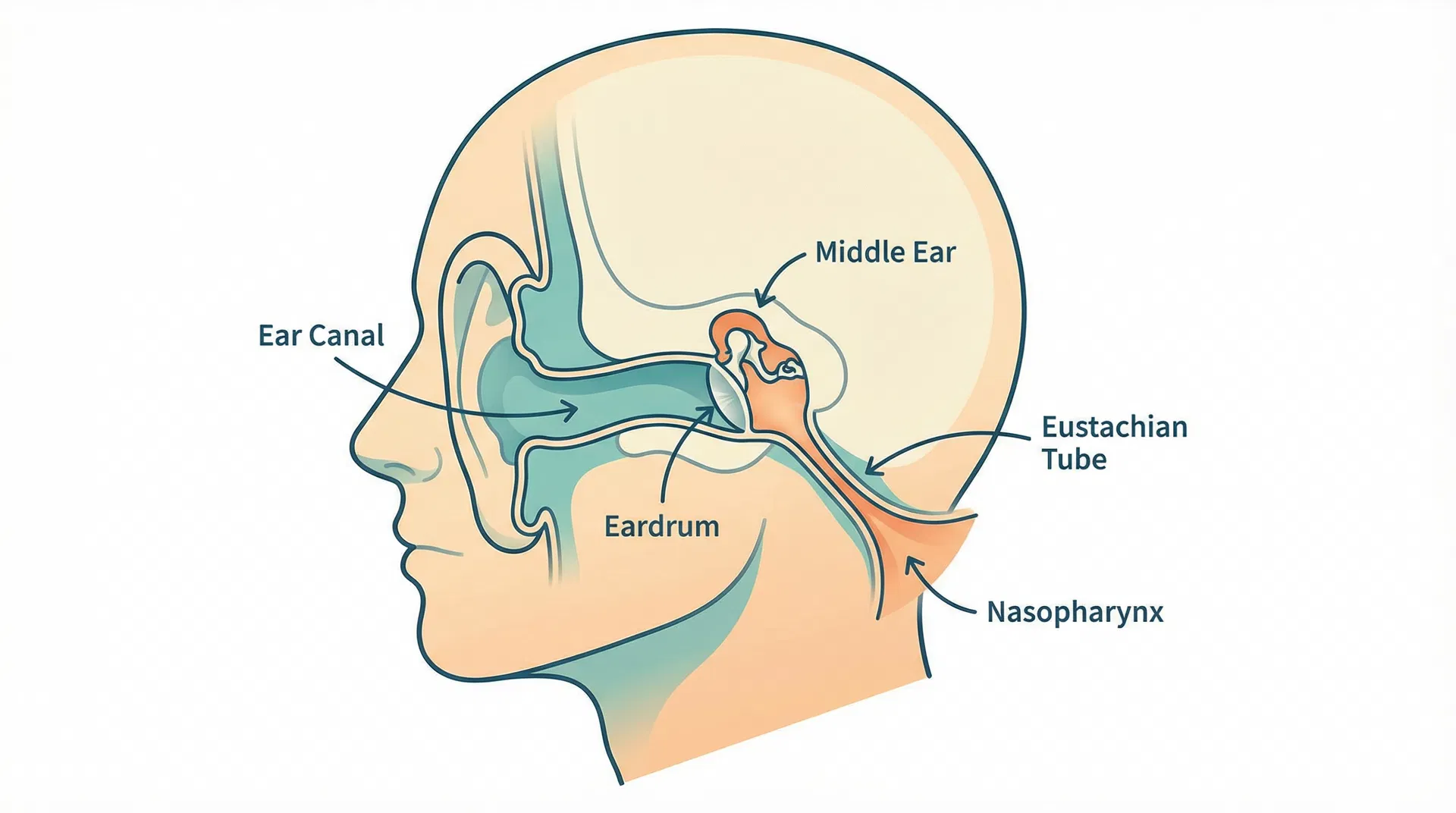
I see patients at Earwax Removal Devon regularly who come in convinced they've got a wax blockage. The symptoms feel identical—muffled hearing, a sense of fullness, sometimes pain. But when I look in their ears, the canal is perfectly clear. No wax at all. The problem isn't in the ear canal. It's deeper than that, in the tiny tubes that connect your middle ear to the back of your throat.
What Exactly Is Eustachian Tube Dysfunction?
Your Eustachian tubes are narrow passages—about 3.5 centimetres long—that run from your middle ear to the upper part of your throat, just behind your nose. You've got one on each side. Their job is straightforward but important: they equalise the air pressure on both sides of your eardrum and drain any fluid that accumulates in your middle ear.
Every time you swallow, yawn, or chew, these tubes open briefly. You don't notice it happening because it's automatic. That tiny click or pop you sometimes hear? That's your Eustachian tubes doing their job.
Eustachian tube dysfunction—ETD for short—affects about 1% of the general adult population, according to the Cleveland Clinic, though the actual number is likely higher because many people don't seek treatment for mild cases.
The NHS Devon health information service describes the condition as one of the most common causes of the sensation of blocked ears—and it's one that's frequently confused with earwax buildup.

The Three Types of ETD
Not all Eustachian tube dysfunction is the same. There are three distinct types, and understanding which one you're dealing with matters for treatment.
Obstructive ETD
This is the most common form. Your Eustachian tubes swell shut or get blocked by mucus, and they won't open when they should. Fluid can build up in your middle ear because it has nowhere to drain. The result is that familiar pressure sensation, muffled hearing, and sometimes pain. Think of it like a drain that's got clogged—everything backs up.
Patulous ETD
This is the opposite problem. Instead of staying closed when they shouldn't, your Eustachian tubes stay open all the time. Sound travels from your nasal cavity directly to your ears, which creates a strange effect where your own voice sounds abnormally loud (a phenomenon called autophony) and your breathing sounds amplified. It's deeply unsettling for people who experience it.
Baro-Challenge-Induced ETD
This type only kicks in when you experience changes in altitude or pressure. Flying is the classic trigger, but it can also happen when you're driving through mountains, scuba diving, or even taking a fast lift in a tall building. Your Eustachian tubes can't adjust quickly enough to the pressure change, and you're left with pain and that blocked feeling until they catch up.
How Do You Know It's ETD and Not Earwax?
This is the question I get asked most often. And honestly, it's a really good one, because the symptoms overlap significantly. Both earwax blockage and ETD can cause muffled hearing, a feeling of fullness, earache, and even tinnitus.
Here's how to start telling them apart.
With earwax, the blockage tends to develop gradually over weeks or months. Your hearing gets progressively worse on one side. There's often no pain unless the wax is pressing directly on the eardrum. And the symptoms don't fluctuate much—once your ear is blocked, it stays blocked until the wax is removed.
ETD behaves differently. The symptoms often come and go. You might notice your ears feel worse when you've got a cold, when your allergies flare up, or when the weather changes. Swallowing or yawning might temporarily relieve the pressure. You might hear clicking or popping sounds. And the symptoms often affect both ears, whereas earwax blockage tends to be one-sided.
But here's the honest truth: you can't always tell from symptoms alone. That's why it's worth having someone look in your ears properly. When you come to see us, we can visualise your ear canal and eardrum clearly. If there's wax, we can see it and remove it. If the canal is clear but your eardrum looks retracted or there's fluid behind it, that points towards ETD.
What Causes Eustachian Tube Dysfunction?
Several things can trigger ETD, and often it's a combination of factors rather than a single cause.
Upper Respiratory Infections
The common cold is far and away the most frequent culprit. When you catch a cold, the mucous membranes lining your nose and throat swell up. Your Eustachian tubes are lined with the same type of tissue, so they swell too. The tubes narrow, mucus gets trapped, and suddenly your ears feel blocked. This is why so many people notice hearing changes when they're ill.
The flu produces the same effect, often more severely. Sinusitis—infection or inflammation of the sinuses—can also cause Eustachian tube swelling because the anatomy is so closely connected.
Allergies
Hay fever, dust mite allergies, pet allergies—any condition that causes nasal inflammation can affect your Eustachian tubes. If you notice your ears feel blocked during pollen season or when you're around certain triggers, allergies are likely playing a role. The inflammatory response doesn't stop at your nose. It extends into your Eustachian tubes and sometimes your middle ear.
Acid Reflux
Here's one that surprises people. Chronic acid reflux—gastro-oesophageal reflux disease, or GORD—can cause Eustachian tube dysfunction. Stomach acid that travels up into the throat can irritate and inflame the tissue around the Eustachian tube opening. The Cleveland Clinic lists GORD as a recognised cause of ETD, and it's something that often gets overlooked.
Pressure Changes
Flying is the most obvious trigger. As the plane ascends or descends, the air pressure in the cabin changes rapidly. Your Eustachian tubes need to open to equalise the pressure, and if they can't keep up—because of a cold, swelling, or just because your tubes are naturally narrow—you get that painful, blocked sensation. Scuba diving creates even more extreme pressure changes and can cause significant problems for people with ETD.
Anatomical Factors
Some people are simply more prone to ETD because of how their Eustachian tubes are built. Children are particularly susceptible because their tubes are shorter, more horizontal, and narrower than adults'. This is why ear infections are so common in young children. In adults, conditions like a deviated nasal septum, enlarged adenoids, or nasal polyps can contribute to tube dysfunction.
The Symptoms in Detail
The Cleveland Clinic describes the most common ETD symptom as muffled hearing—"almost like you're underwater." That's a perfect description.
But the full picture includes several other symptoms that can range from mildly annoying to genuinely debilitating.
A feeling of fullness or pressure in one or both ears is almost universal with ETD. It's that sensation of your ears being stuffed or plugged, and it can be constant or come and go throughout the day.
Clicking or popping sounds happen when your Eustachian tubes try to open. You might notice these when you swallow, yawn, or move your jaw. Some people find them reassuring—at least the tubes are trying to work. Others find them irritating.
Ear pain ranges from a dull ache to sharp, stabbing discomfort. It's caused by the pressure difference between your middle ear and the outside environment. The pain often worsens with altitude changes or when lying down.
Dizziness and balance problems occur because your middle ear plays a role in your vestibular system. When pressure builds up behind your eardrum, it can affect the signals your brain receives about balance and spatial orientation.
Tinnitus—ringing, buzzing, or humming in your ears—can develop when ETD changes the pressure dynamics in your middle ear. If you're experiencing tinnitus alongside blocked ears, it's worth considering ETD as a possible cause, particularly if there's no wax present.
Hearing loss in more severe or prolonged cases can become noticeable. The fluid buildup in your middle ear dampens the vibrations that transmit sound, reducing your ability to hear clearly. This is called conductive hearing loss, and it's usually reversible once the ETD resolves.
When ETD Becomes Serious
Most cases of Eustachian tube dysfunction clear up on their own within one to two weeks, particularly if they're triggered by a cold or mild allergic reaction. But chronic ETD—where symptoms persist for weeks, months, or even years—is a different matter.
Left untreated, chronic ETD can lead to complications. Fluid that sits in the middle ear for extended periods can become infected, causing otitis media (middle ear infection). Repeated infections or prolonged negative pressure can damage the eardrum, potentially causing it to retract or even perforate. In rare cases, untreated ETD contributes to permanent hearing loss and structural damage to the middle ear.
This isn't meant to frighten you. Most ETD resolves without any of these complications. But it's the reason you shouldn't ignore symptoms that hang around for more than a couple of weeks.
How Is ETD Diagnosed?
Diagnosis starts with a proper look at your ears. A clinician will examine your ear canals and eardrums, your nasal passages, and the back of your throat. A retracted eardrum or visible fluid behind the eardrum are strong indicators of ETD.
Tympanometry is a quick, painless test that measures how well your eardrum moves in response to changes in air pressure. A normal result shows a clear peak on the graph, indicating good middle ear function. With ETD, the graph often shows a flat line or a shifted peak, suggesting fluid or negative pressure in the middle ear.
Hearing tests can determine whether you have conductive hearing loss—the type associated with middle ear problems—as opposed to sensorineural hearing loss, which originates in the inner ear or auditory nerve.
If you come to us with symptoms of blocked ears and we find no earwax, we'll explain what we can see and recommend the appropriate next steps. Sometimes that means a referral to an ENT specialist for further investigation.

Treating Eustachian Tube Dysfunction
Treatment depends on the cause and severity. The good news is that most cases respond well to simple measures.
Self-Help Techniques
For mild ETD, these can make a real difference:
-
Swallowing, yawning, and chewing gum all activate the muscles that open your Eustachian tubes. If you're on a flight and feel your ears blocking up, chewing gum or sucking on a sweet can help enormously.
-
The Valsalva manoeuvre involves breathing out gently whilst pinching your nostrils closed and keeping your mouth shut. You should feel a gentle pop as your Eustachian tubes open. Don't force it—gentle pressure is all you need. Blowing too hard can actually cause damage.
-
Saline nasal spray helps clear mucus from your nasal passages and can reduce swelling around the Eustachian tube openings. It's drug-free, safe for regular use, and available from any pharmacy.
-
The Otovent device is a small balloon you inflate using your nose. It creates gentle positive pressure that helps open your Eustachian tubes. It's particularly useful for children and for people who struggle with the Valsalva manoeuvre.
Medications
When allergies are driving the ETD, antihistamines like cetirizine can help reduce the inflammatory response. Steroid nasal sprays such as fluticasone (Flonase) are particularly effective because they reduce swelling directly in the nasal passages and around the Eustachian tube openings.
For ETD caused by infection, your GP may prescribe antibiotics if there's evidence of bacterial involvement. Corticosteroids can help with significant inflammation.
One word of caution about decongestants like pseudoephedrine (Sudafed). Whilst they can help with nasal congestion, the Cleveland Clinic notes that they can actually make Eustachian tube dysfunction worse in some cases. Use them cautiously and speak to your pharmacist or GP first.
Pain relief with paracetamol or ibuprofen can help manage discomfort whilst you wait for the underlying cause to resolve.
Surgical Options
For chronic ETD that doesn't respond to conservative treatment, surgery may be considered. NICE has issued guidance on balloon dilation for chronic Eustachian tube dysfunction, a procedure called eustachian tuboplasty. A small balloon is threaded through the nasal passages into the Eustachian tube, inflated for about two minutes to widen the tube, then deflated and removed. Recovery is typically within 24 hours.
Other surgical options include myringotomy—a small incision in the eardrum to drain fluid—and the insertion of grommets (ear tubes) to provide ongoing ventilation of the middle ear. These are usually reserved for cases where other treatments have failed.
The Connection Between ETD and Earwax
Here's something worth knowing. ETD and earwax buildup can coexist. You can have Eustachian tube dysfunction and a wax blockage at the same time, which makes symptoms worse and diagnosis trickier.
This is one reason why getting your ears properly examined matters. If you've got wax blocking your ear canal, removing it with microsuction or ear irrigation will improve your hearing—but if there's also ETD underneath, you might still have some residual symptoms. Knowing what you're dealing with means you can address both issues appropriately.
When to Seek Help
If your symptoms are mild and you've recently had a cold, give it a couple of weeks. Use the self-help techniques. Try saline nasal spray. There's a good chance things will settle on their own.
But see someone if your symptoms last longer than two weeks, if you're experiencing significant pain, if your hearing loss is getting worse, or if you develop discharge from your ear. These could indicate complications that need proper assessment.
And if you're not sure whether your blocked ears are caused by wax or ETD, come and see us. We can look in your ears, tell you exactly what's going on, and either treat the problem there and then or point you in the right direction. We see patients across Devon—from Barnstaple and Ilfracombe to Exeter and Plymouth—and we offer home visits for those who can't easily travel.
Don't sit at home wondering what's wrong with your ears. Whether it's wax, ETD, or something else entirely, getting an answer is the first step to feeling better. Book an appointment or give us a call on 01769 302119. We're here to help you hear clearly again.


